

Table of contents
- Key Takeaways
- Dating Photo Editing Statistics: 73% Want Heavy Retouching Banned
- Do Professional Dating Photos Get More Matches?
- How Important Are Photos on Dating Apps?
- Misleading Dating Photos: 89% Have Met Someone Who Looked Different
- Most Common Tinder Profile Photo Types: Nine Styles Found in 1,000 Profiles
- Dating Profile Photo Trends by Age, Gender, and Sexual Orientation
- How Common Are Revealing Photos on Tinder?
- How Often Do People Update Their Dating Profile Photos?
- Dating Profile Pet Photos: 15% of Men Have Borrowed a Pet
- Dating Photo Statistics FAQ
- Sources
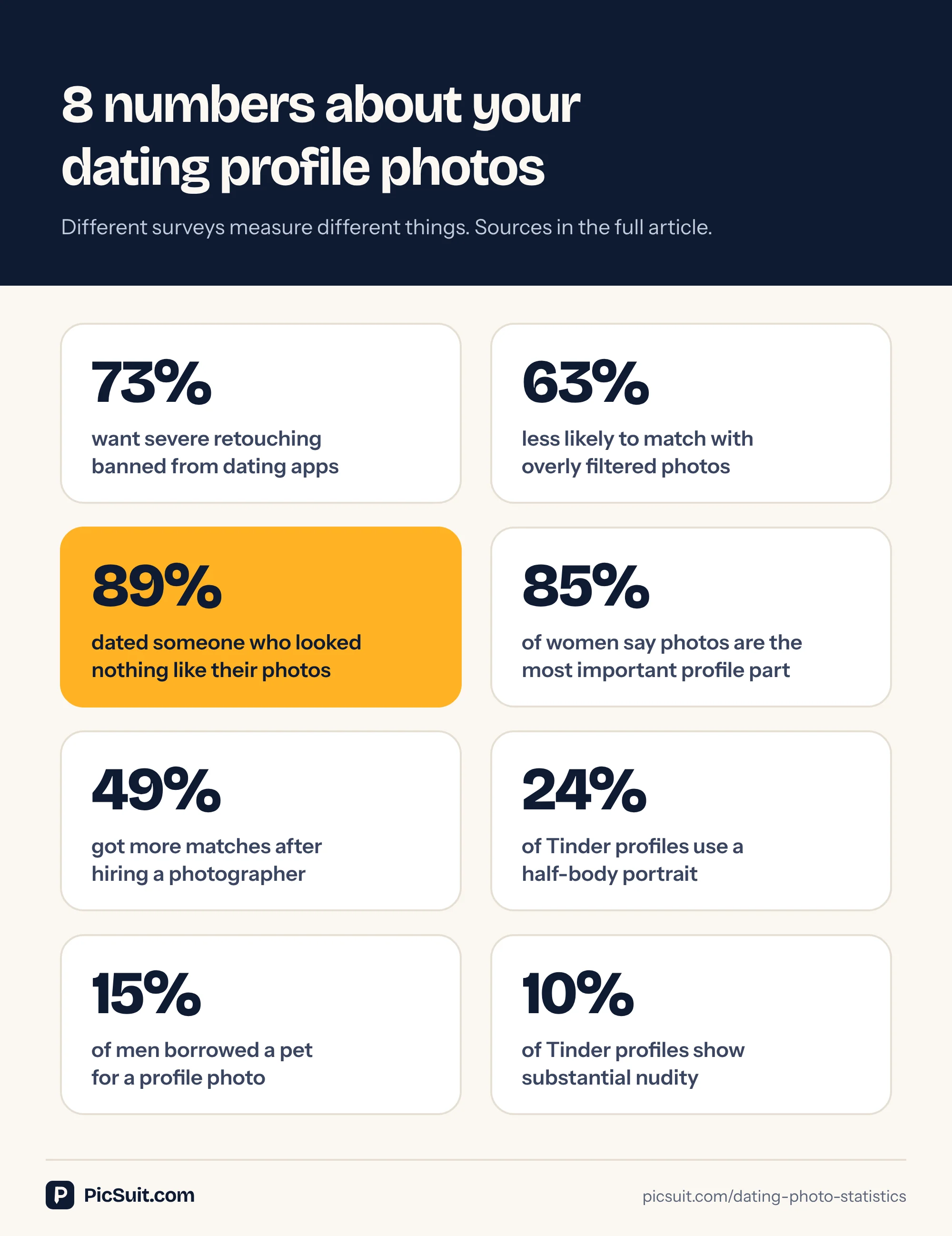
Dating photo statistics reveal an awkward contradiction: 73% of dating-app users wanted severe photo retouching banned, yet 89% said they had met someone who looked nothing like their dating-profile pictures.
Photos also appear to shape the attention people receive: 49% of people who hired a dating photographer reported getting more matches.
And in a separate analysis of 1,000 real Tinder profiles, researchers found that the most common photo style accounted for 24% of the sample.
Here is what the numbers show about photo preferences, actual Tinder profiles, and the limits of claims about getting more matches.
Key Takeaways
- 73% of dating-app users wanted severe photo retouching banned from dating platforms.
- 49% of people who hired a photographer for dating pictures reported receiving more matches afterward.
- 85% of women said photos were the most important part of a dating profile in a U.S. survey.
- 89% of singles said they had gone on a date with someone who looked nothing like their profile photos.
- 24% of Tinder profiles in a Barcelona-area study featured a half-body portrait facing the camera, the most common of nine photo styles identified.
- Only 10% of Tinder users in that study had profile pictures showing substantial nudity.
- 63% of U.S. dating-app users said overly edited or filtered pictures made them less likely to match with someone.
Dating Photo Editing Statistics: 73% Want Heavy Retouching Banned
73% of dating-app users wanted severe image retouching banned in a 2022 survey of 997 people in the United States. The question concerned major changes to someone’s appearance, such as reshaping facial features or body outlines.
62% of men were comfortable with light photo editing, such as small cosmetic touch-ups, in the same survey. The distinction matters: accepting minor edits does not necessarily mean accepting photos that misrepresent someone’s appearance.
63% of dating-app users said overly edited or filtered photos would make them less likely to match in a separate 2024 U.S. survey of 1,000 adults. That study measured dating-profile dealbreakers, not support for a platform-wide editing ban.
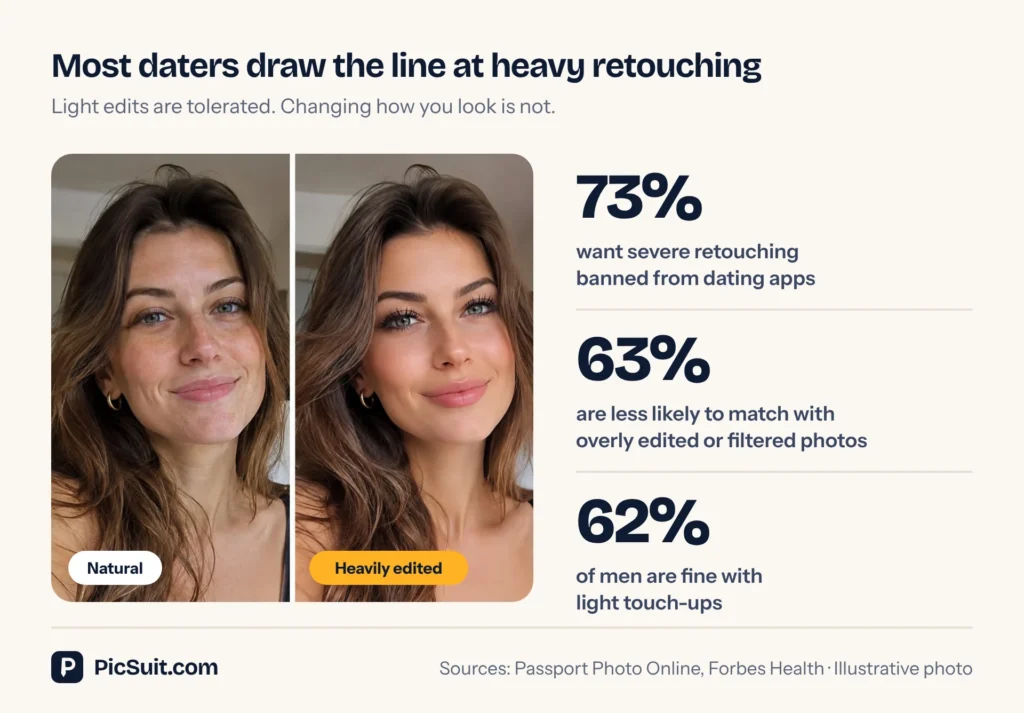
| What people said about dating photos | Finding | Study context |
|---|---|---|
| Severe photo retouching should be banned | 73% | U.S. survey, 2022 |
| Men are comfortable with light photo editing | 62% | U.S. survey, 2022 |
| Overly edited or filtered photos can prevent a match | 63% | U.S. survey, 2024 |
These percentages answer different questions. They cannot be used to claim that attitudes toward photo editing improved or worsened between the studies.
Do Professional Dating Photos Get More Matches?
49% of people who hired a photographer for dating pictures said they received more matches in the 2022 U.S. survey. This measures the share reporting an improvement. It does not mean professional photos increased everyone’s match count by 49%.
The same respondents also described changes in the attention their profiles received after hiring a photographer.
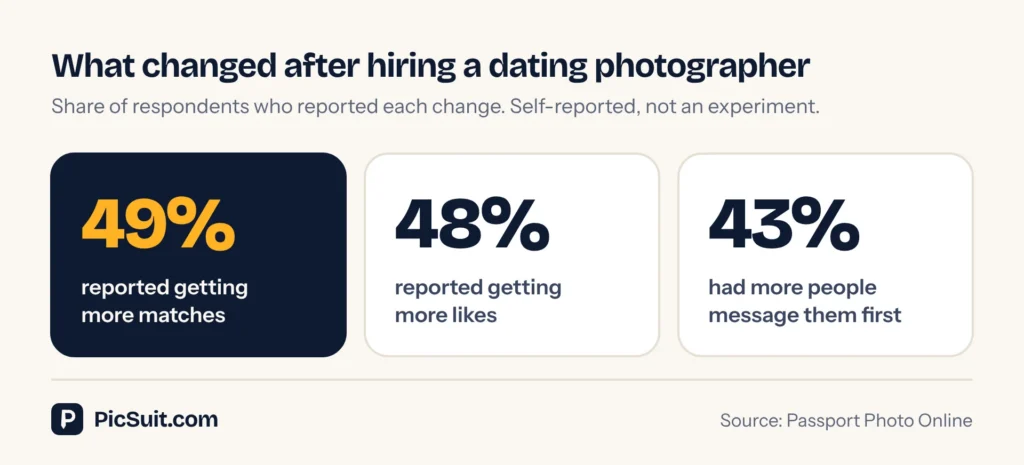
| Reported result after hiring a dating photographer | Share of respondents |
|---|---|
| Received more matches | 49% |
| Received more likes | 48% |
| Had more people message them first | 43% |
These were personal reports, not outcomes from a controlled experiment. A new set of photos may coincide with changes to a bio, app activity, or other parts of a profile. The available data cannot isolate the photographer’s effect.
The practical case for professional photography is simpler: sharp, flattering pictures can help people present themselves clearly. No study cited here establishes a guaranteed increase in match rate.
How Important Are Photos on Dating Apps?
85% of women said pictures were the most important part of a dating profile in the 2022 U.S. survey. This is a measure of perceived importance, not the percentage of matches that can be attributed to photos.
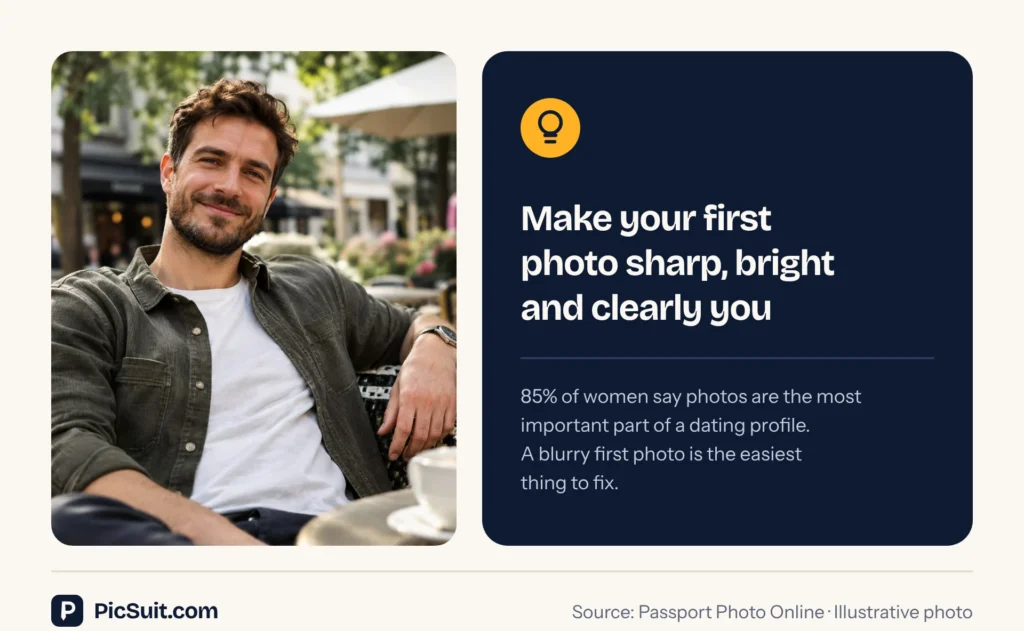
A separate experiment with Tinder-style profiles found that image clarity and visual presentation influenced how participants evaluated potential dates. Participants rated constructed profiles; the researchers did not measure actual Tinder match totals.
For someone building a dating profile, that distinction changes how the evidence should be used. Clear photos are worth prioritizing, but there is no reliable formula here proving that a particular pose or filter produces a specific number of matches.
Misleading Dating Photos: 89% Have Met Someone Who Looked Different
89% of singles said they had been on a date with someone who looked nothing like their online photos in the 2022 U.S. survey. The question asked whether they had ever experienced such a date. It did not measure the share of all dates involving misleading pictures.
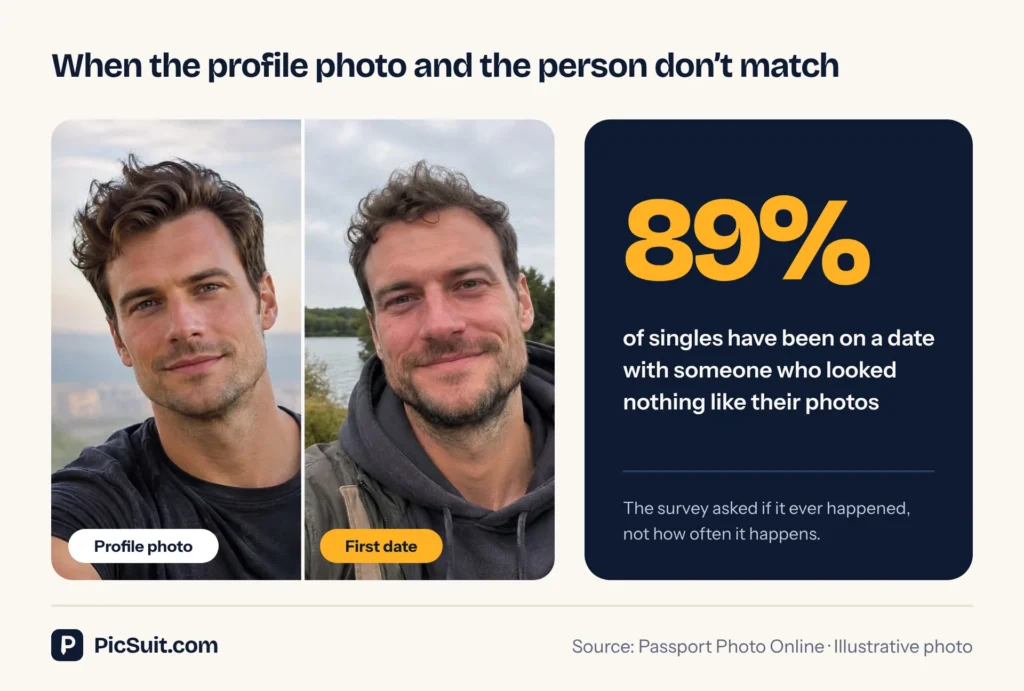
The mismatch may come from outdated images, heavy retouching, or photographs that give an unrepresentative impression. The survey does not establish which explanation was most common.
A useful check is whether a person meeting you today would recognize you from your profile. A photo can be appealing without creating an expectation that falls apart in person.
Most Common Tinder Profile Photo Types: Nine Styles Found in 1,000 Profiles
24% of Tinder profiles featured a half-body portrait facing the camera, making it the most common visual style in a study of 1,000 profiles from the Barcelona area. Researchers classified the profile pictures into nine recurring styles rather than measuring how many matches each style earned.
The breakdown provides a concrete picture of how users actually present themselves on Tinder.
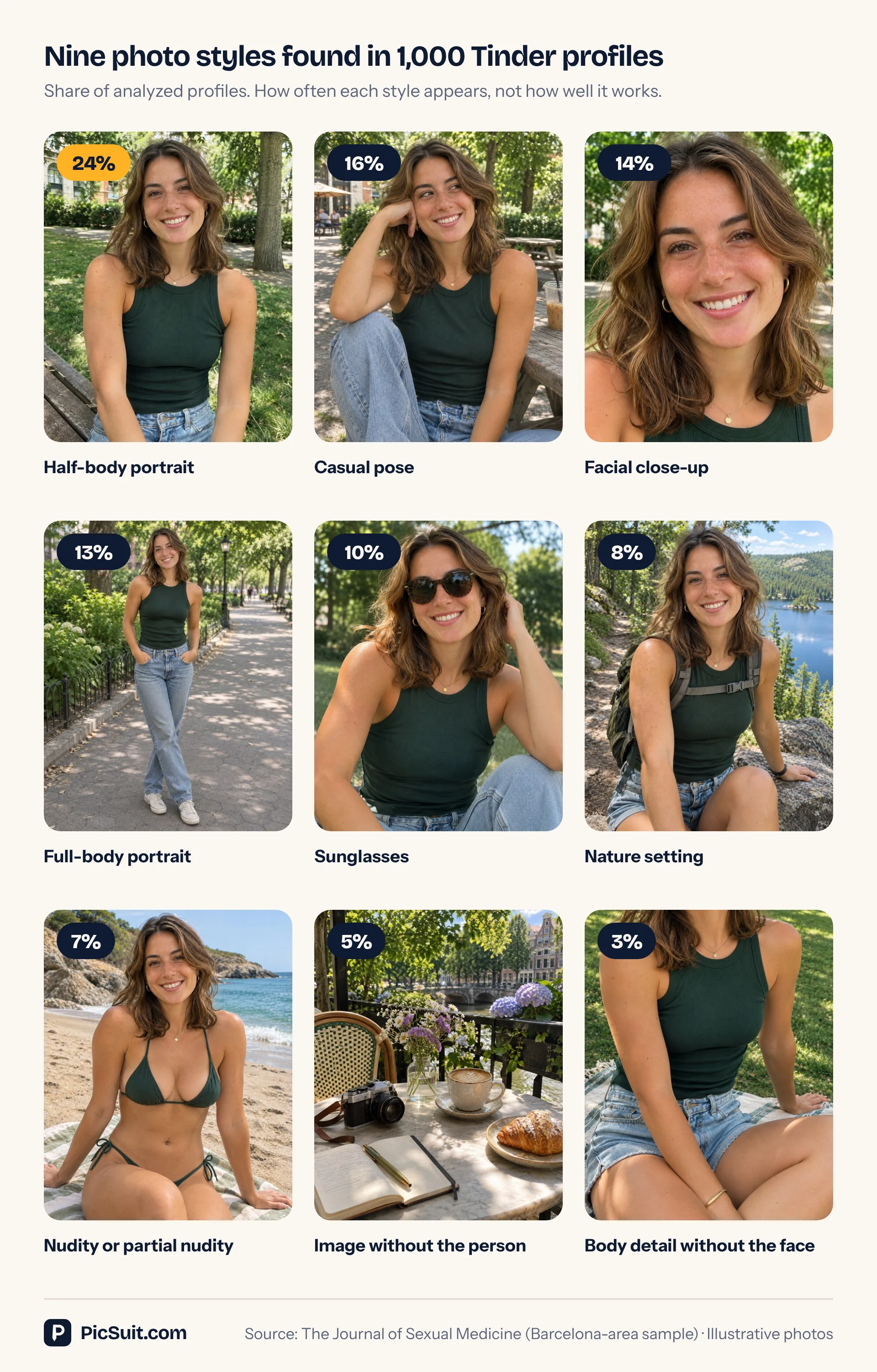
| Tinder photo style | Share of analyzed profiles | What the photo typically shows |
|---|---|---|
| Half-body portrait | 24% | Upper body visible, looking at the camera |
| Casual pose | 16% | Looking away from the camera, often appearing candid |
| Facial close-up | 14% | Face emphasized, usually facing the camera |
| Full-body portrait | 13% | Entire body visible, looking at the camera |
| Sunglasses | 10% | Wearing sunglasses as a prominent visual feature |
| Nature setting | 8% | Photographed outdoors, often in natural surroundings |
| Nudity or partial nudity | 7% | Body emphasized, including swimwear or revealing photos |
| Image without the person | 5% | Landscape, object, or other image without the user’s face or body |
| Body detail without the face | 3% | Part of the body shown without the head |
The categories and shares summarize the Barcelona-area Tinder study published in 2025. The percentages describe the observed classification of this sample, not the success rate of each photo type.
The top category is straightforward: a visible face, direct eye contact, and enough of the upper body to recognize the person. More elaborate pictures were less common in this sample. Frequency alone does not tell us which style gets more right swipes.
What the nine photo styles do and do not show
The study measured how people choose to present themselves. It did not track profile impressions, likes, matches, or dates for each category. A half-body portrait’s popularity therefore makes it a common choice, not a scientifically proven winning choice.
The sample also came from one geographic area. Cultural norms and the mix of people using the app may differ elsewhere, so these percentages should not be described as a worldwide Tinder average.
Dating Profile Photo Trends by Age, Gender, and Sexual Orientation
Age was more strongly associated with photo-presentation style than gender or sexual orientation in the analysis of 1,000 Tinder profiles. Younger users tended to show more of their bodies, while older users more often selected images that concealed part of their appearance.
Among users aged 50 and older, pictures without the person’s body became more common. This was an observed pattern in the sample, not a recommendation that people in any age group should hide or reveal more.
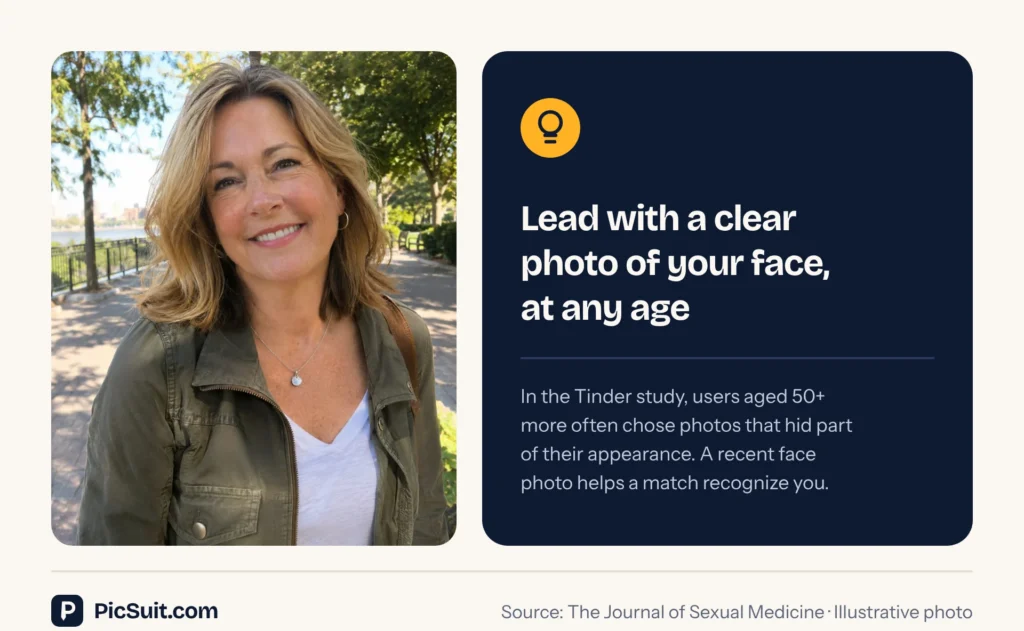
Photo choices among women and men
Heterosexual women in the study more often chose full-body portraits and were more likely to smile. Heterosexual men more often used action-oriented photos or natural settings and tended to show less of their bodies.
The researchers also observed differences by sexual orientation. Lesbian women tended to show less of their bodies and smile less than heterosexual women, while gay men more often looked directly at the camera and smiled than heterosexual men.
These findings describe group-level patterns in a Barcelona-area sample. They cannot predict an individual’s preferences, and they do not show which photo styles produce better dating outcomes for different groups.
How Common Are Revealing Photos on Tinder?
Only 10% of Tinder users in the Barcelona-area analysis had profile pictures with a substantial degree of nudity. This was assessed using an image-analysis measure rather than users’ own descriptions of their pictures.
7% of profiles were placed in a visual category characterized by nudity or partial nudity. These images often emphasized the body, sometimes in swimwear or beach settings.
3% belonged to a category featuring body parts without the face. This was the least common of the nine photo styles identified in the study.
The 10% figure measures substantial nudity, while 7% and 3% describe separate visual categories. Although the numbers look related, they represent different classifications and should not be combined into a new nudity statistic.
How Often Do People Update Their Dating Profile Photos?
26% of U.S. dating-app users said they last updated their profile pictures one to six months earlier in the 2022 survey. That is one reported time period, not a recommended schedule for replacing photos.

The study also found that older photos were common enough to matter, but it did not test whether updating pictures at a particular interval produces more matches. A better rule is to replace images when they no longer represent your current appearance.
If your hairstyle, everyday look, or preferred activities have changed significantly, newer pictures can set more accurate expectations for the first meeting.
Dating Profile Pet Photos: 15% of Men Have Borrowed a Pet
15% of men admitted to borrowing a pet for their dating-profile photo in the 2022 U.S. survey. It is a striking example of how people use pictures to suggest qualities about their lives.
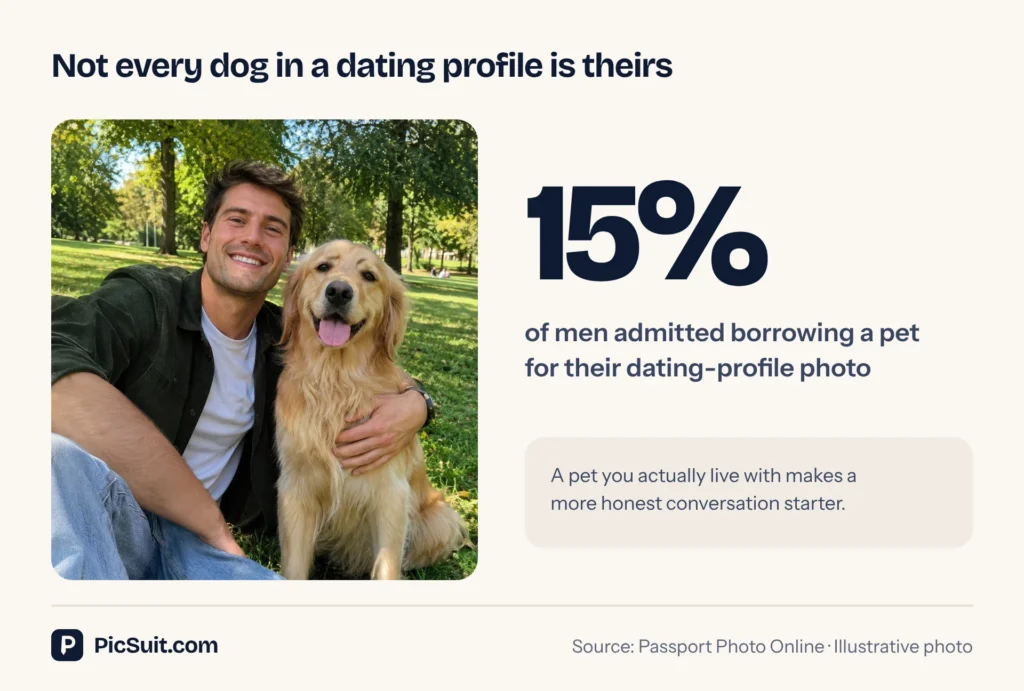
An animal in a photo can make a profile more personal, but a borrowed pet can also create an impression that does not reflect everyday reality. The survey did not measure whether borrowing a pet increased matches.
Choose images that communicate something true about your life. A pet you actually spend time with offers a more accurate conversation starter than a staged photo designed solely to attract attention.
Dating Photo Statistics FAQ
What percentage of dating-app users dislike heavily edited photos?
73% of dating-app users in a 2022 U.S. survey wanted severe retouching banned. A separate 2024 U.S. study found that 63% considered overly edited or filtered pictures a reason not to match. These studies asked different questions, so the findings should not be interpreted as a change over time.
Do professional dating photos get more matches?
49% of people who had hired a dating photographer reported more matches afterward in a 2022 U.S. survey. That is the percentage of people reporting an improvement, not a 49% increase in the number of matches. The survey does not establish how much of that change was caused by the photos alone.
What is the most common Tinder profile picture?
Half-body portraits facing the camera made up 24% of profiles in a study of 1,000 Tinder profiles from the Barcelona area. Researchers identified nine common presentation styles. The result establishes which style appeared most often in that sample, but it does not identify the style with the highest match rate.
What are the nine most common Tinder photo styles?
Nine styles emerged from the 1,000-profile analysis: half-body portraits, casual poses looking away, facial close-ups, full-body portraits, sunglasses, nature settings, nudity or partial nudity, images without the person, and body details without the face. Their shares ranged from 24% for half-body portraits to 3% for body details without a face.
Do Tinder photo preferences change with age?
Age was the strongest demographic factor associated with presentation style in the Barcelona-area study. Younger users tended to show more of their bodies, while users aged 50 and older were more likely to use pictures that did not show their bodies. These findings describe observed behavior, not which images received the most matches.
How many Tinder profiles show nudity?
10% of Tinder users in the analyzed Barcelona-area sample had profile pictures showing substantial nudity. The same study separately identified a 7% nudity-or-partial-nudity photo category and a 3% body-detail category. The latter two are photo-style groups; they should not be treated as independent measures of the overall nudity rate.
How often should you update dating profile photos?
26% of U.S. dating-app users in a 2022 survey had updated their pictures one to six months earlier. That figure describes what people reported doing, not an ideal update frequency. Replace your photos whenever they no longer look like you, particularly if your profile may create a misleading impression before an in-person date.
Sources
- Passport Photo Online, How Dating Profile Photos Affect Your Decision to Swipe Left or Right (2022 study; page updated 2025). Original survey of 997 U.S. respondents; source of the 73%, 49%, 85%, 89%, 62%, 26%, and 15% findings and the photographer follow-up responses.
- Forbes Health, What Makes the Perfect Dating Profile? (2024). Original survey of 1,000 U.S. dating-app users; source of the 63% edited-photo dealbreaker finding.
- García-Alamán, Blanco-Cuaresma, and Montesano, Stereotypical Love: A Cluster Analysis of Self-Presentation Strategies in Tinder Profile Pictures (The Journal of Sexual Medicine, 2025). Peer-reviewed study of 1,000 Tinder profiles from the Barcelona area; original research behind the nine-style classification and demographic patterns.
- Universitat Oberta de Catalunya, Tinder and Visual Identity: A Study Reveals the Nine Types of User Profile Photos (2026). University summary of the original study, including the 24%, 10%, 7%, and 3% findings and demographic interpretation.
- Sexual Medicine Society of North America, Spanish Tinder Habits by Gender, Age, and Sexual Orientation (2025). Research summary providing the full percentage breakdown across all nine Tinder photo categories.
- Dai and Xia, The Impacts of Media Richness, Blurriness, and Beautification of Online Dating Profile Visual Elements on Dating Outcomes (Frontiers in Communication, 2025). Experimental research on participants’ evaluations of Tinder-style profiles.