

Table of contents
- Key Takeaways
- LinkedIn Photo Statistics: Profile Views and Engagement
- LinkedIn Profile Photo Statistics: Recruiter Decisions
- How Many LinkedIn Profiles Have a Professional Photo in 2026?
- Professional LinkedIn Headshots by Seniority and Industry
- AI-Generated LinkedIn Headshot Statistics
- Professional LinkedIn Photo Quality: Framing and First Impressions
- Can LinkedIn Photos Introduce Bias?
- Frequently Asked Questions
- Sources
Could your LinkedIn photo be costing you job opportunities?
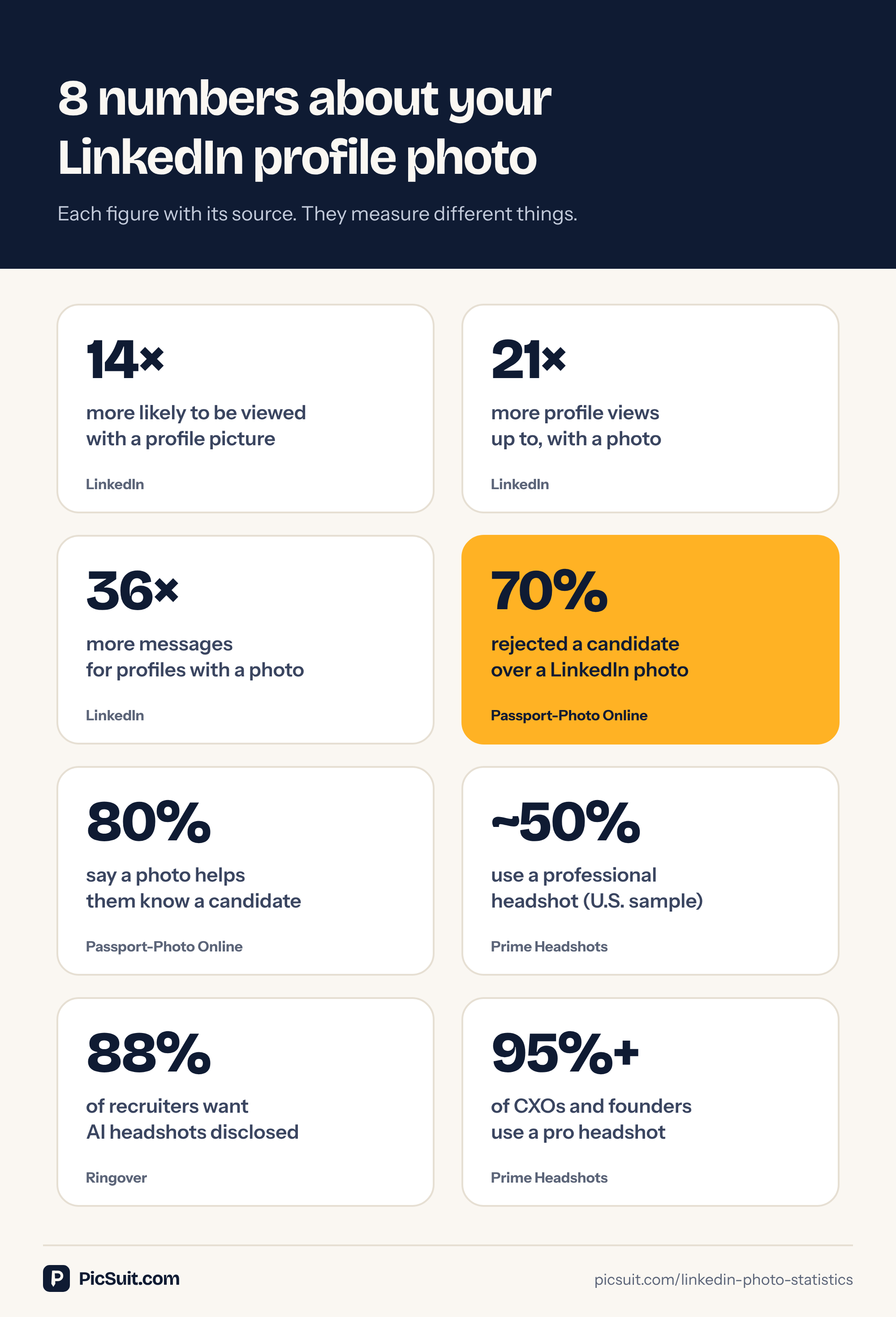
LinkedIn profiles with a picture are 14 times more likely to be viewed, yet 70% of HR professionals, managers, and business owners in one survey admitted to rejecting a candidate because of their profile photo.
And despite the importance of making a good first impression, only about half of the profiles examined in a recent U.S. study featured a professional headshot.
These LinkedIn photo statistics reveal how much your picture can matter for profile visibility, recruiter decisions, and professional credibility.
Key Takeaways
- LinkedIn profiles with a photo are 14 times more likely to be viewed than profiles without one.
- 70% of HR professionals, managers, and business owners surveyed have rejected a job candidate because of their LinkedIn profile picture.
- LinkedIn users with a profile picture can receive up to 36 times more messages than users without one.
- 80% of HR professionals, managers, and business owners surveyed believe a LinkedIn photo helps them get to know a candidate better.
- About 50% of the LinkedIn profiles examined in a U.S. study featured professional headshots, while the rest used casual photos or had no picture.
- 88% of U.S. recruiters surveyed want candidates to disclose when their headshots are AI-generated.
LinkedIn Photo Statistics: Profile Views and Engagement
14 times more likely to be viewed was the figure published in August 2024 for profiles with a picture. The underlying research year was not disclosed, and the claim concerns having a photo, not whether a studio portrait performs better than every other photograph.
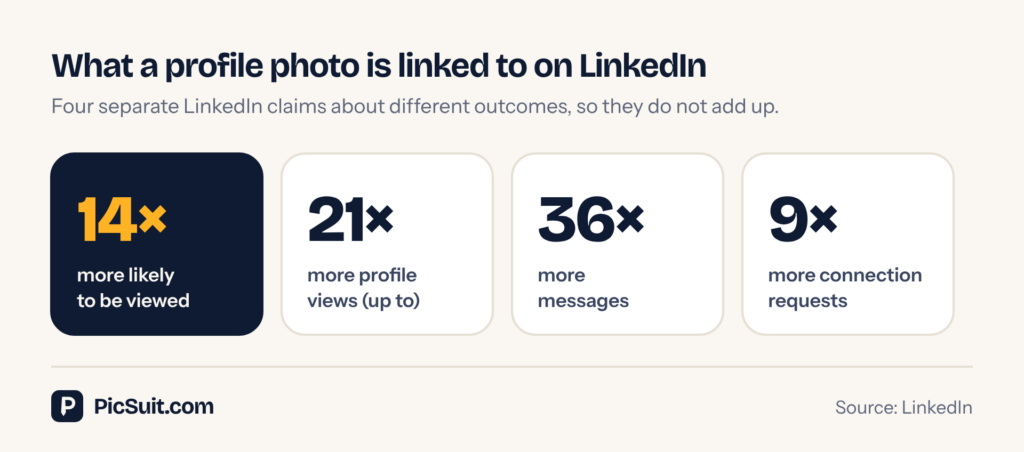
Up to 21 times more profile views was the figure published in March 2017 for profiles with a photo. The older statistic remains widely cited, but it is not a 2026 measurement.
36 times more messages was the figure reported for photo-bearing profiles in September 2019. It refers to messages generally; the original statement does not identify all of them as recruiter InMail.
9 times more connection requests was the figure published in 2017 for profiles with a photo. Connection requests, messages, and profile views are different outcomes, so their multipliers should not be combined into a single performance score.
| LinkedIn profile-photo finding | Reported figure | Publication year |
|---|---|---|
| Profile more likely to be viewed when it has a picture | 14 times | 2024; research year not stated |
| Additional profile views with a photo | Up to 21 times | 2017 |
| More messages for profiles with a photo | 36 times | 2019 |
| More connection requests with a photo | 9 times | 2017 |
The 14-times and 21-times view figures were published separately. The available methodological detail does not establish a comparable year-by-year trend, and neither multiplier demonstrates that adding a photo alone causes the entire difference.
LinkedIn Profile Photo Statistics: Recruiter Decisions
70% of HR professionals, managers, and business owners said they had turned down a candidate because of that person’s LinkedIn profile picture. The survey year was not disclosed, and the finding describes self-reported behavior rather than a measured rejection rate across job applications.
80% of these HR professionals, managers, and business owners said a candidate’s profile picture helped them get to know the person better. This comes from the same survey as the 70% finding, not a separate independent study.
Over 87% of the HR professionals, managers, and business owners considered professionalism essential when rating profile pictures. This is a reported preference, not an objective measure of job performance.
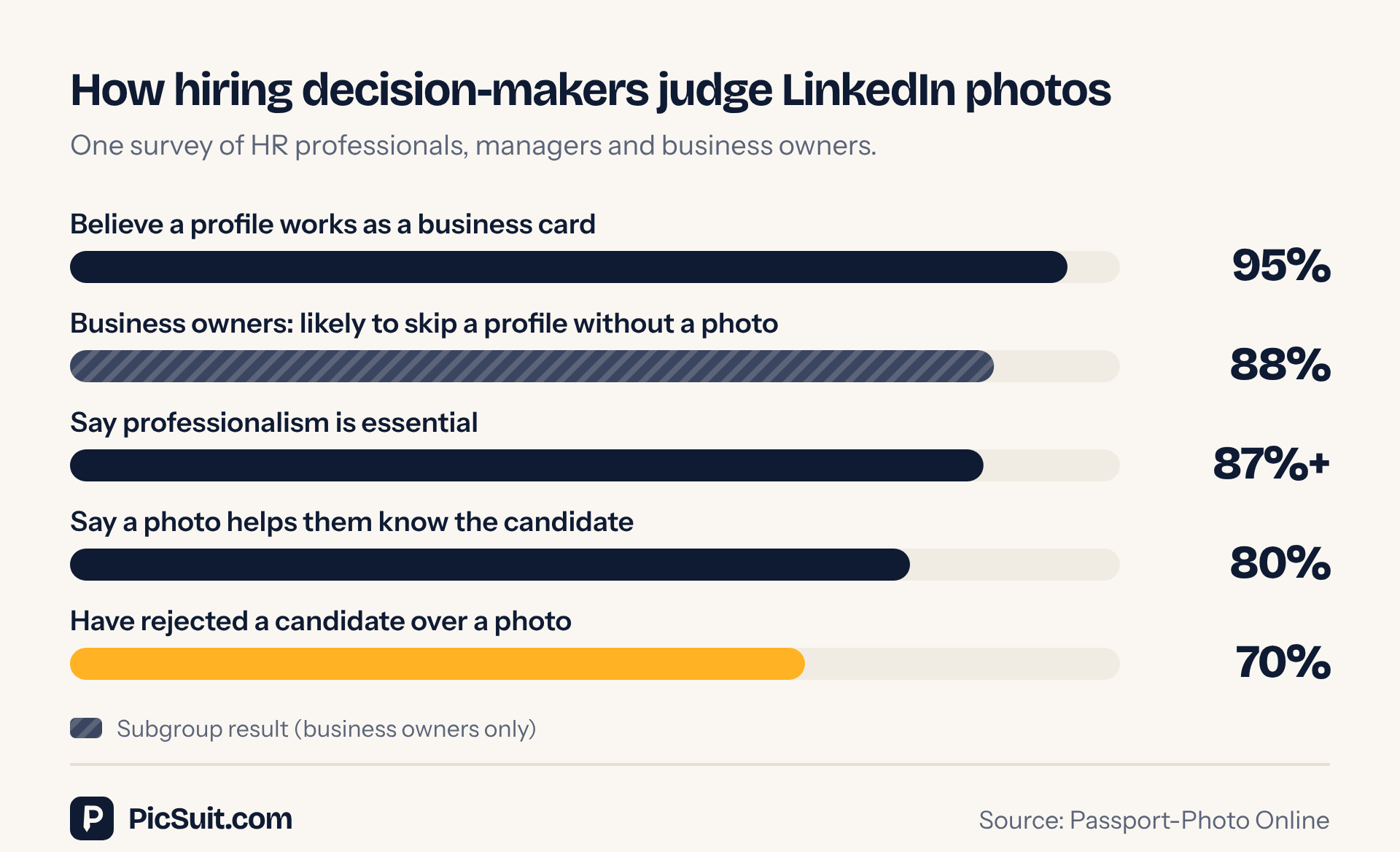
88% of business owners said they were likely to overlook candidates without a LinkedIn picture. This figure reflects a subgroup of the same survey, not all participants.
95% of the HR professionals, managers, and business owners believed a LinkedIn profile acts as a business card. The finding reflects this mixed group of hiring decision-makers, not the wider population; the survey year is not disclosed.
| Survey question or finding | Figure | Who was measured |
|---|---|---|
| Had turned down a candidate because of their LinkedIn photo | 70% | HR professionals, managers, and business owners |
| Said a candidate photo helps them get to know the person | 80% | HR professionals, managers, and business owners |
| Considered professionalism essential when rating photos | Over 87% | HR professionals, managers, and business owners |
| Likely to overlook candidates without a picture | 88% | Business-owner subgroup |
| Believed LinkedIn profiles function as a business card | 95% | HR professionals, managers, and business owners |
All figures in this table come from the same survey; its fieldwork year was not disclosed.
How Many LinkedIn Profiles Have a Professional Photo in 2026?
About 50% of the profiles in a July 2026 review used a professional headshot. The analysis covered 14,506 public LinkedIn profiles associated with 608 U.S.-based companies.
About 40% of profiles in the same review used a selfie, a casual photo, or an old or blurred image. These were classified as nonprofessional photos by the study’s reviewers.
About 10% of profiles in the review had no photo at all. The study’s proportions describe its selected public U.S. company profiles, not every member of LinkedIn worldwide.
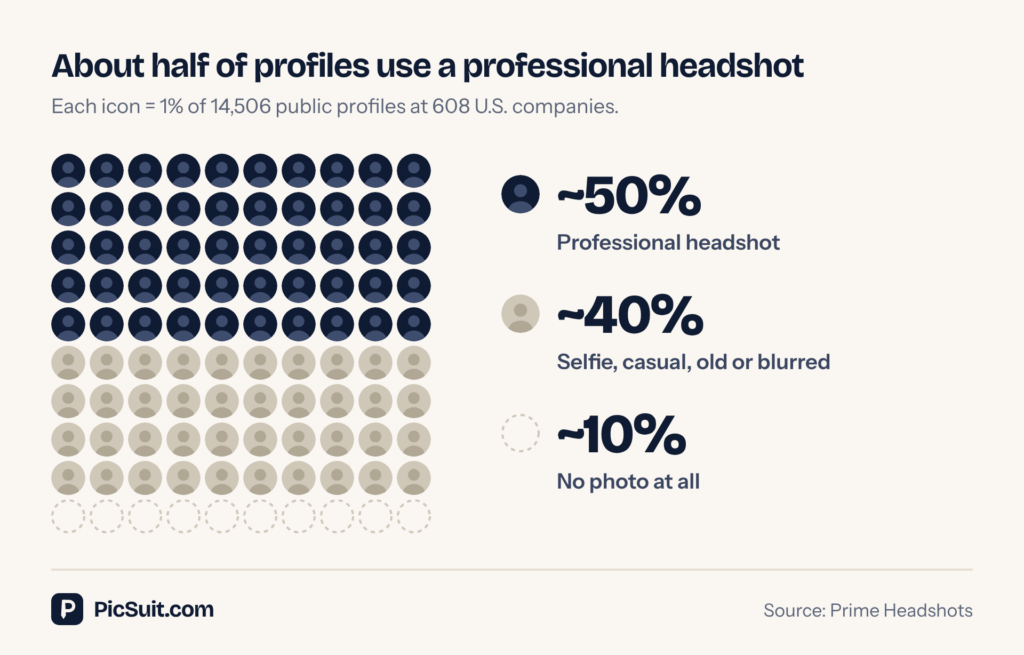
| Photo classification | Share of reviewed public profiles | Study coverage |
|---|---|---|
| Professional headshot | About 50% | 14,506 profiles; 608 U.S. companies |
| Nonprofessional photo | About 40% | Same sample |
| No profile photo | About 10% | Same sample |
The classification relies on visual judgments and a company-based, U.S.-only sample. The findings make a useful industry benchmark, but they should not be reported as a platform-wide census.
Professional LinkedIn Headshots by Seniority and Industry
More than 95% of CXOs and founders in the July 2026 sample used a professional headshot. That was the highest adoption level among the seniority groups highlighted in the analysis.
About 80% of senior-management profiles in the same review displayed a professional headshot. The difference from executive profiles suggests that professional-photo norms vary by job seniority within this sample.
About 50% of middle-management profiles used professional headshots. This is a sample-level observation rather than evidence that a headshot creates career progression.
Below 30% of entry-level profiles used professional headshots. This makes entry-level profiles the lowest-adoption seniority group noted in the 2026 report.
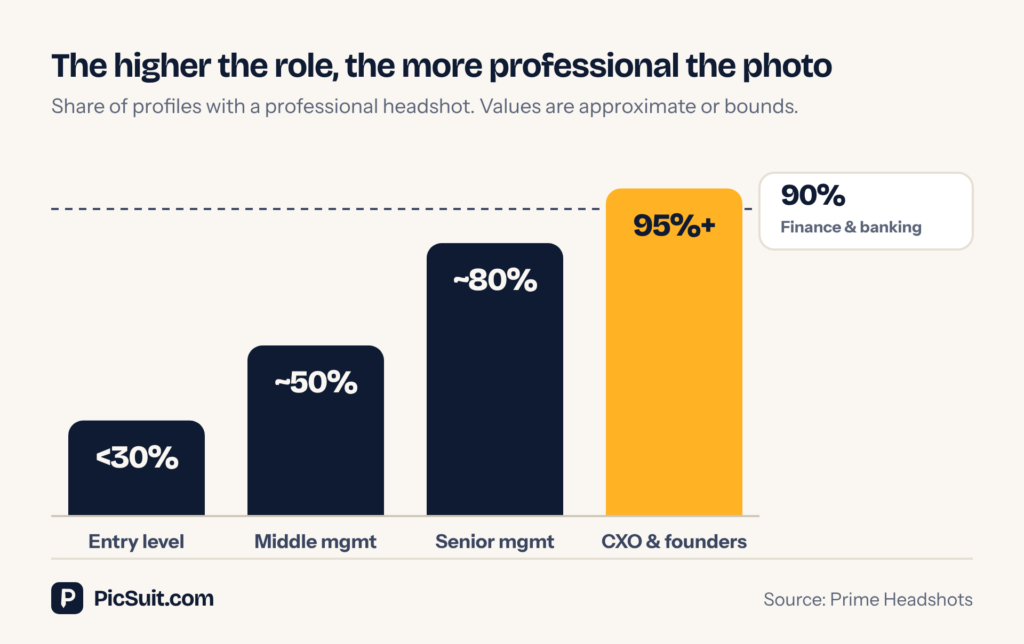
90% of finance and banking profiles in the same July 2026 sample used professional headshots. The figure illustrates how adoption can differ by industry as well as by career stage.
| Seniority or industry category | Professional headshot adoption |
|---|---|
| CXOs and founders | More than 95% |
| Senior management | About 80% |
| Middle management | About 50% |
| Entry level | Below 30% |
| Finance and banking | 90% |
The finance and banking row is an industry measure, not another seniority level. All values come from the same July 2026 review.
AI-Generated LinkedIn Headshot Statistics
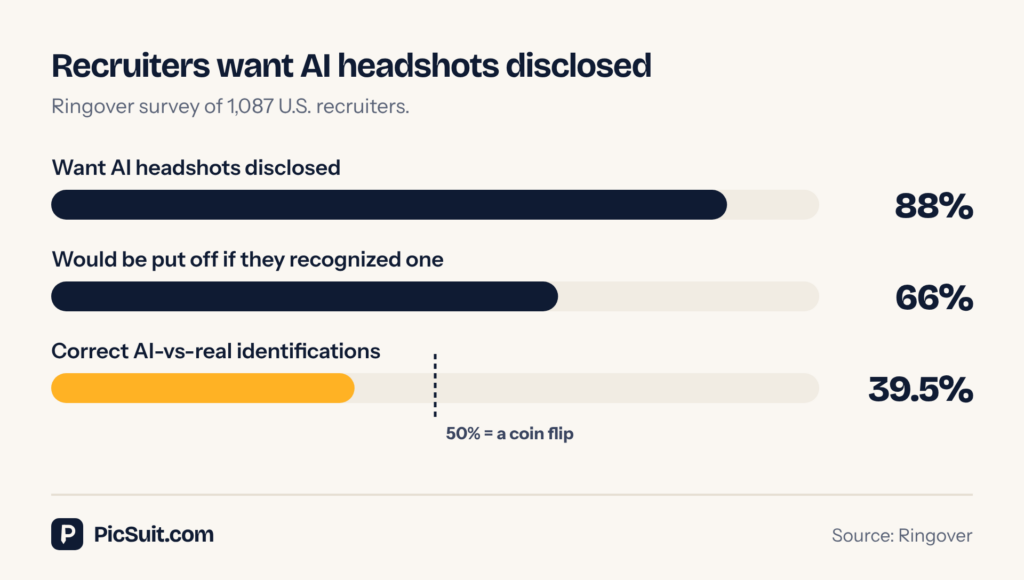
88% of recruiters in a June 2024 survey believed candidates should disclose when a headshot is AI-generated. The study covered 1,087 U.S.-based recruiters and asked about headshots used in job applications, not only on LinkedIn.
39.5% of AI-versus-real headshot identifications in that survey were correct. Recruiters were asked to identify whether images were AI-generated or real, making this an image-classification result rather than a measure of AI-headshot usage on LinkedIn.
66% of recruiters said they would be put off if they recognized a candidate’s headshot as AI-generated. This is a stated reaction, not a measured interview or hiring outcome.
| AI-headshot survey measure | Finding | What it represents |
|---|---|---|
| Want AI-generated headshots disclosed | 88% | Recruiter opinion |
| Correctly identified AI-generated versus real photos | 39.5% | Image-classification accuracy |
| Would be put off by a recognized AI-generated headshot | 66% | Stated recruiter reaction |
This recruiter survey does not provide a verified count of how many LinkedIn members use AI-generated portraits. Claims about increases in AI-photo adoption should not be inferred from these responses.
Professional LinkedIn Photo Quality: Framing and First Impressions
About 60% of the frame should be occupied by the face, according to photo guidance published in August 2024. This is a recommendation for cropping, not a measured share of people who follow it.
+0.33 on perceived competence was the average rating difference associated with a visible-teeth smile in a published photo-rating study. The original collection year was not specified on the research page last updated in 2023.
100 milliseconds of exposure was enough for participants to form facial-trait impressions that correlated with judgments made without time limits in a 2006 psychology experiment. This was not a LinkedIn-specific test.
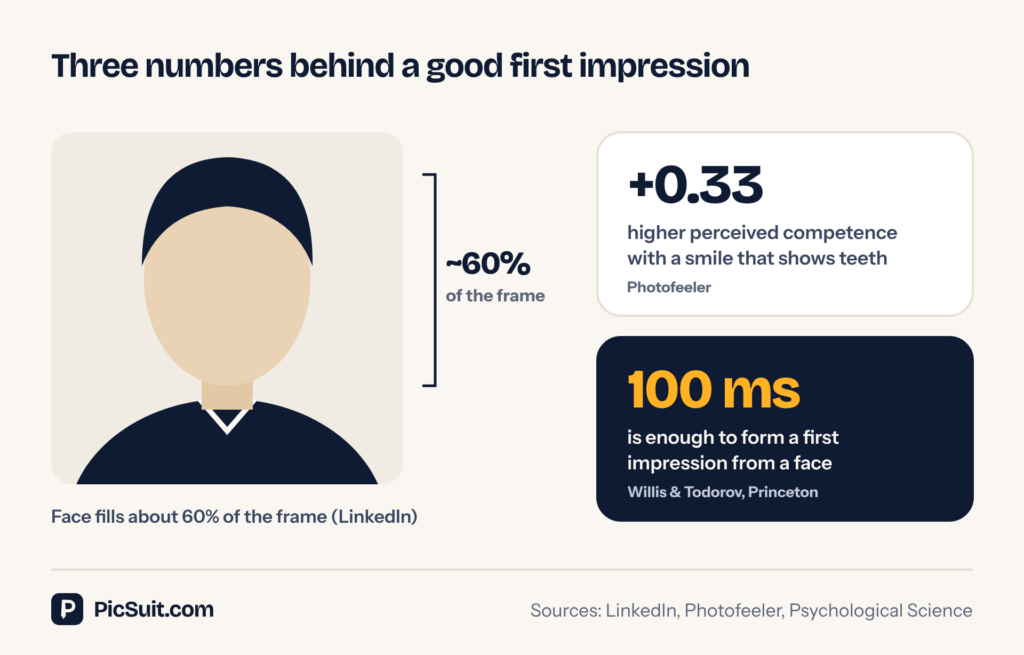
These figures measure different things: a platform design recommendation, ratings of photos, and judgments of unfamiliar faces. They help explain why a clear photo may matter, but none is evidence that a particular expression guarantees better hiring outcomes.
Can LinkedIn Photos Introduce Bias?
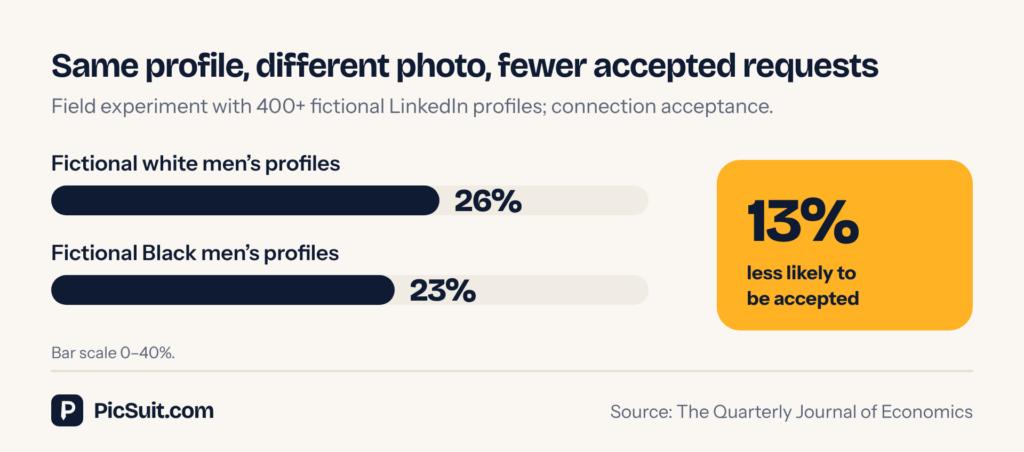
13% less likely to be accepted was the difference for connection requests from fictional Black men’s profiles versus fictional white men’s profiles in a 2024 LinkedIn field experiment involving more than 400 fictional profiles. The researchers varied profile pictures while keeping professional background information comparable.
23% of connection requests from the fictional Black men’s profiles were accepted in the experiment, compared with 26% for the fictional white men’s profiles. These figures concern specific experimental profiles and connection acceptance, not hiring decisions or the effects of using versus omitting a photo.
| Fictional profile group | Connection requests accepted |
|---|---|
| Black men’s profiles | 23% |
| White men’s profiles | 26% |
The study shows that profile imagery can transmit demographic cues that affect networking behavior. A photo may improve visibility on average while also exposing individuals to unequal treatment.
Frequently Asked Questions
How much does a LinkedIn profile picture increase profile views?
14 times more likely to be viewed is a figure published in 2024, although the underlying data year was not disclosed. An up to 21-times profile-views figure was published in 2017. These are separate historical claims, not comparable annual results.
Do LinkedIn profiles with photos receive more messages?
36 times more messages is the multiplier published in a 2019 article for profiles that include a photo. The statistic is often repeated alongside older view and connection-request figures. It does not demonstrate that the photo itself caused the difference, or that every message came from a recruiter.
Can a LinkedIn profile photo affect a recruiter’s decision?
70% of HR professionals, managers, and business owners said they had rejected a candidate because of that candidate’s LinkedIn photo. The underlying survey was updated online in 2025, but its fieldwork year was not disclosed. The result describes self-reported decisions, not a representative global rejection rate.
What percentage of LinkedIn profiles have professional headshots?
About 50% of profiles in a July 2026 review had a professional headshot. The analysis covered 14,506 public profiles across 608 U.S. companies, offering a sample-based benchmark rather than a figure for every LinkedIn member. The profiles were manually classified as professional, nonprofessional, or missing photos.
What percentage of LinkedIn profiles have no picture?
About 10% of the public LinkedIn profiles analyzed in July 2026 had no photo. This was a company-based U.S. sample, not an audit of all profiles worldwide. The review also distinguished absent photos from selfies, casual photos, and blurry older images, which formed a separate category.
Are AI-generated LinkedIn headshots accepted by recruiters?
88% of U.S. recruiters in a June 2024 survey wanted disclosure when candidates used AI-generated headshots. In the same survey, 66% said recognizing such a photo would put them off. These answers measure stated preferences, not LinkedIn-wide policy or actual hiring rates.
What is the recommended face size in a LinkedIn profile picture?
About 60% of the frame is the face-coverage target in photography guidance published in August 2024. A clear shoulders-up crop is recommended so the person remains recognizable at small display sizes. This percentage is editorial advice, not a controlled experimental result.
Sources
- LinkedIn (2024). “10 Tips for Taking a Professional LinkedIn Profile Photo.” Original LinkedIn advice for the 14-times viewing claim and the 60% face-framing recommendation. Read original source
- LinkedIn (2017). “LinkedIn Profile Photo Tips: Introducing Photo Filters and Editing.” Historical figures for profile views and connection requests. Read original source
- LinkedIn / Andrew Seaman (2019). “What About Your LinkedIn Profile?” The 36-times messaging claim. Read original source
- Passport-Photo Online (updated 2025; survey year undisclosed). “Does a LinkedIn Picture Affect Your Hireability?” Research with HR professionals, managers, and business owners. Read original source
- Prime Headshots (2026). “LinkedIn Headshot Trends 2026.” Review of 14,506 public profiles at 608 U.S. companies. Read original source
- Ringover (2024). “Does an AI Headshot Make You More Hireable?” Survey of 1,087 U.S. recruiters. Read original source
- Photofeeler (study year unspecified). “The Perfect Photo” research on facial expression and perceived competence. Read original source
- Willis, J., and Todorov, A. (2006). “First Impressions: Making Up Your Mind After a 100-ms Exposure to a Face.” Psychological Science. Read original source
- The Quarterly Journal of Economics (2024 study publication). LinkedIn field experiment on racial bias in connection requests. Read original source